
But what do banks gain by opening their apps for all? The answer -- rival bank's customers under their fold.

In rupee terms, India's market cap is currently about Rs 184 trillion - 90 per cent of the GDP of Rs 203 trillion for FY20 at current prices.

'Investors should put their money in stocks where the margin of safety is high.'

Shares of all the 14 companies are currently trading above their issue price.

Experts said banking is a play on the economy and the latest buying into this space is underpinned by hopes of a sharper-than-expected recovery in the economy.

'When there is unlocking, there is demand revival.' 'This is going to be the main growth engine in this kind of an economic scenario.'

Assuming that the value of LIC's holding has risen in line with the markets, its portfolio size today could be around $86 billion, higher than the previous record of $84 billion in March 2018.

The total default is said to be in excess of Rs 3,000 crore - making this the largest default by a broker.
Maximum promoter holding to be eligible for reclassification to be raised from 10% to 15%; waiting time to be brought down to one month from three.
The move will increase working capital requirement for brokers, raise the work load on the system and will leave little room for contingencies.
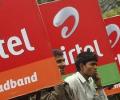
While Airtel has hiked the limit to 100 per cent in principle, the company needs to address some issues on overseas investment limits in subsidiaries, before the changes come into effect. Until then, the cap on foreign ownership will remain at 49 per cent under the automatic route.

A bunch of CEOs in their mid-30s and early 40s are trying to rectify the scenario where shady lending applications trap hapless borrowers with astronomically high interest rates and even bodily harm if the money was repaid. Anup Roy reports.

The markets regulator, Securities and Exchange Board of India (Sebi), recently introduced fresh guidelines to determine the place of a mutual fund (MF) on its riskometer tool.

The NSE held 25 to 100 per cent stakes in these entities through its subsidiary NSE Investments as of September.

The spreads between state development loans and equivalent-maturity government papers have started widening, and market participants don't expect them to contract anytime soon. The rise in spreads is a direct measure of market displeasure than a rise in yields.

T'I am not going to buy small- or mid-cap stocks at very high valuations if it doesn't make sense for the investors.'

Banks say they themselves red-flagged the transactions to RBI. It must be noted that these transactions are not outright evidence of fraud or proof of nefarious activities.

As a result, the deadline for filing June quarter results ends on August 15. However, only 1,538 companies out of the 4,000-odd listed firms managed to declare their results within the usual deadline.

China is the world's second-largest - both in terms of GDP and m-cap. At $10 trillion, its m-cap is second only to the US at $38 trillion.

Several brokers used shares of dormant or inactive clients to provide margins for other more active clients. This prompted Sebi to rework its entire system of pledging.
